
Teaching Reading Comprehension to ESL Students: Effective Strategies for All Levels
Teaching Reading Comprehension to ESL Students: Effective Strategies for All Levels
Why Reading Comprehension Matters for ESL Learners
When we’re teaching reading comprehension to ESL students, we’re not just teaching a school skill. We’re teaching them how to:
Decode words and letters.
Make sense of sentences and paragraphs.
Connect the text to their own experiences and world knowledge.
Reading is a social and linguistic practice.
Our learners bring rich languages, stories, and cultural knowledge with them. If we design tasks that tap into this, we’re already improving reading comprehension for ESL learners before they’ve even opened the book.
How to Teach Reading Comprehension in ESL Classrooms
One helpful way to plan is through Luke and Freebody’s Four Roles of the Reader. It’s a simple framework that keeps you focused on more than just decoding.
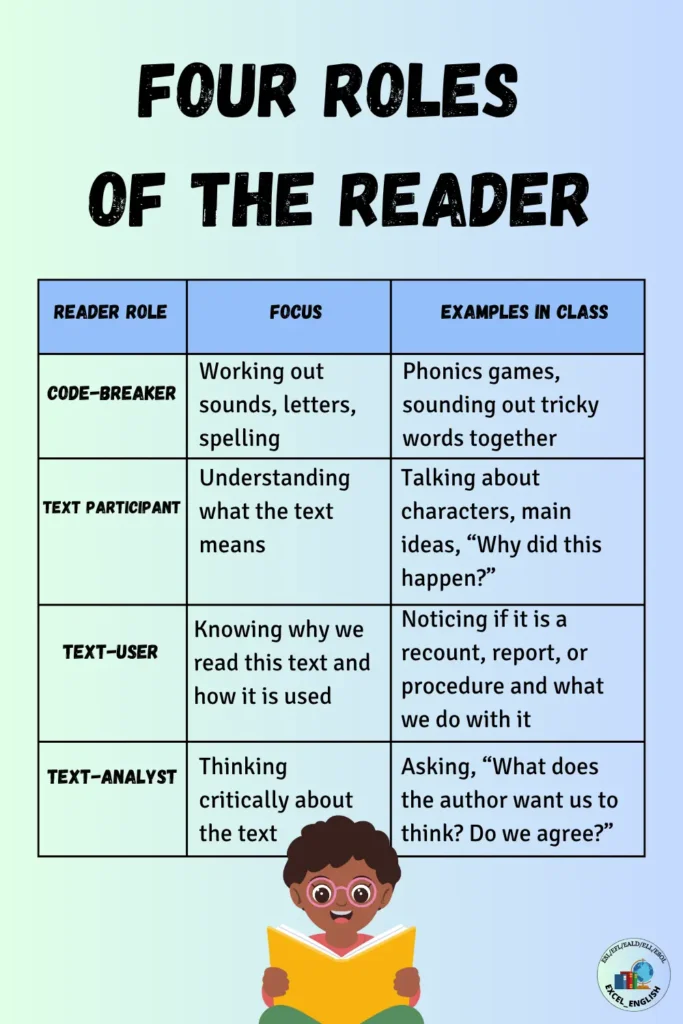
When you intentionally plan for all four, you’re teaching reading comprehension strategies ESL learners can transfer across subjects, not just in English time.
Teaching Reading Comprehension to ESL Students: Effective Strategies for All Levels
Scaffolded Reading Comprehension in ESL Classrooms
EAL/D students rarely benefit from “just read it and answer the questions.”
They need scaffolded reading comprehension (ESL) – temporary supports that help them reach the goal and then slowly fade away.
Think about scaffolding as:
I do – you model the strategy.
We do – you and the class do it together.
You do – students try it with support, then independently.
Some simple scaffolds you can build in:
Joint construction – read a short paragraph together and co-construct a summary on the board.
Text reconstruction – cut up a model text into strips; students rebuild it in pairs.
Cloze activities – remove key verbs or nouns to focus on grammar, meaning, or vocabulary.
Visual organisers – flow charts, Venn diagrams, and mind maps to show relationships.
These supports are perfect for differentiated reading comprehension ESL lessons where you have mixed levels in one room (so… most Australian classrooms!).

Teaching Reading Comprehension to ESL Students: Effective Strategies for All Levels
2. During Reading – Build Meaning Together
Here’s where guided reading ESL strategies shine.
As you read, pause and model:
Literal questions – “Who is this about? What happened?”
Inferential questions – “Why did the miners go on strike?” “How do we know the wolf is dangerous?”
Evaluative questions – “Do you think this was fair?” “What would you do?”
You can also:
Highlight conjunctions that show cause and effect.
Ask students to underline topic sentences.
Use information transfer – for example, filling in a “who / when / where / why” table about three little pigs.
3. Cloze Activities with a Purpose
Cloze doesn’t have to be random blanks.
You can target:
Vocabulary – delete key nouns or verbs from a familiar text.
Grammar – delete articles, prepositions, or conjunctions.
Meaning – delete words that signal cause and effect.
Students use context clues and grammar knowledge to complete the sentences. This is great for improving reading comprehension for ESL learners and building syntactic awareness.

Teaching Reading Comprehension to ESL Students: Effective Strategies for All Levels
4. Text Reconstruction
Give pairs or small groups a paragraph cut into sentence strips.
Their job:
Arrange the sentences in the correct order.
Justify their choices using clues like connectives and pronouns.
This helps students see how an information report or recount is organised, and why cohesion matters. It also naturally leads to writing.
5. Reading Aloud and Shared Reading
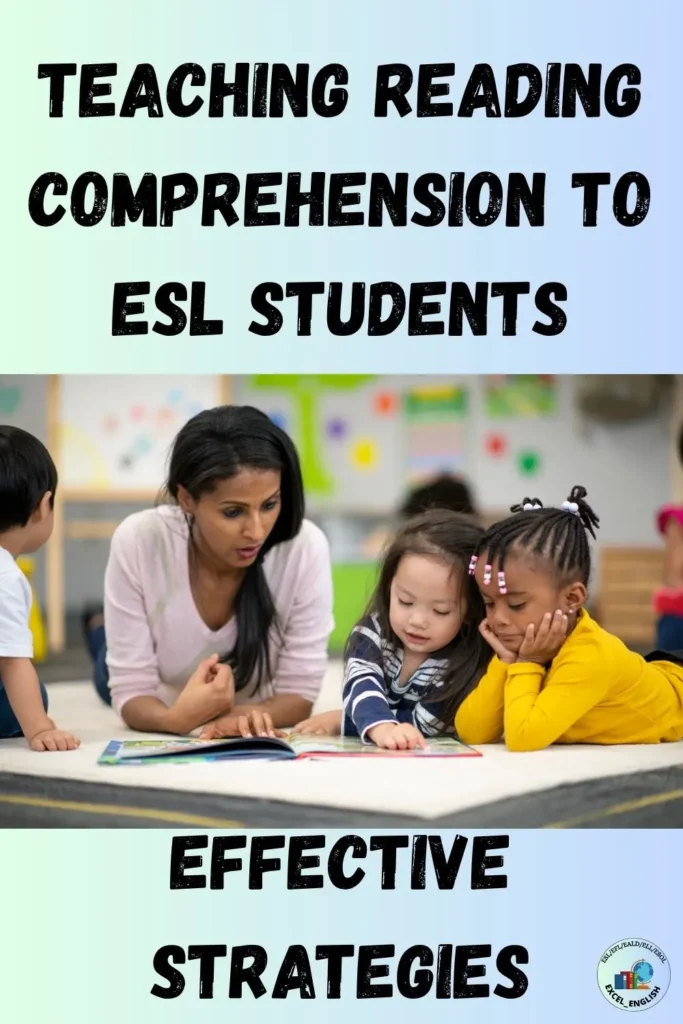
Even upper-primary learners benefit from hearing a fluent reader.
In teaching reading to EAL/D students, shared reading lets you:
Model pronunciation, stress, and intonation.
Pause to unpack tricky phrases.
Invite choral reading or echo reading so they can try it too.
Building Vocabulary, Grammar, and Genre Knowledge
Strong comprehension grows from strong language.
You can boost reading skills for English learners by:
Explicitly teaching key vocabulary before reading (with pictures, actions, or translations where appropriate).
Highlighting morphology – prefixes, suffixes, and word families.
Re-using the same words across different texts and tasks.
Linking vocabulary to grammar in context – showing how noun groups, verbs, and conjunctions work inside sentences.
At the same time, teach text structure and genre awareness:
Point out headings, topic sentences, and cohesive devices.
Sort mixed-up paragraphs into introduction, description, and conclusion.
Compare different genres: recount vs information report vs procedure.
This doesn’t have to be heavy or “academic” – short, focused bursts sprinkled through lessons can make a huge difference.
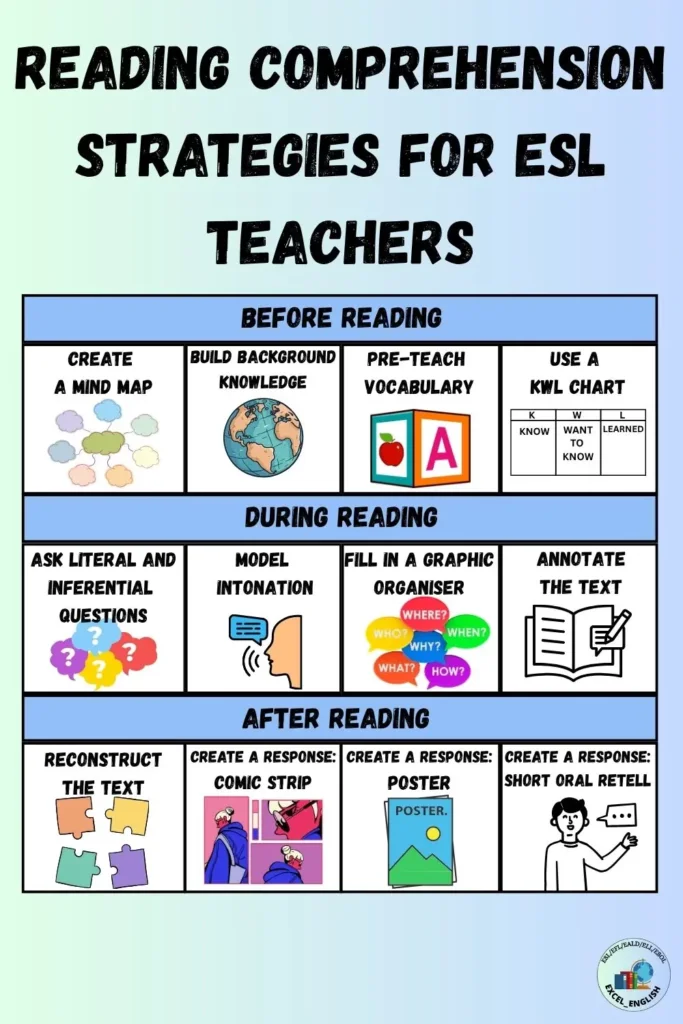
Quick Reference: Teaching Reading Comprehension Strategies to ESL learners
Here’s a simple table you could screenshot or print as a planning reminder.
Conclusion: Bringing It All Together
Teaching reading comprehension to ESL students doesn’t mean reinventing your entire program. It means being intentional about how you prepare, support, and extend your learners.
When you:
Use clear before–during–after reading routines,
Build in scaffolded reading comprehension (ESL) supports,
And choose a few effective ESL reading strategies that you use consistently,
you’ll see students move from “reading the words” to truly understanding and using the ideas in your texts.
If you’d like to keep improving reading comprehension for ESL learners in your class, choose one strategy from this post and try it in your next lesson – maybe a mind map, a cloze, or a text reconstruction.
Then notice:
Who joined in that usually sits back?
Who suddenly had more to say about the text?