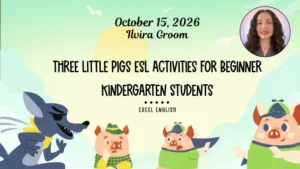
This term with my newly arrived EAL/D students, we focused on Three Little Pigs EAL/D activities – engaging and visual storytelling lessons designed to support English language learners. Fairy tales are timeless stories that help build vocabulary, comprehension, and confidence in speaking and writing.
Some of my students have been in Australia for two or three terms, while others joined us only last term. Fairy tales are perfect for this mix of learners because they’re visual, repetitive, and emotionally engaging. They offer predictable structures, repeated language patterns, and strong visuals that help students learn English naturally through storytelling.
Puppet Storytelling: Three Little Pigs EAL/D Activities in Action
To introduce the story, I used puppets and told the story with expressive intonation, gestures, and facial expressions. The moment the big bad wolf appeared, students leaned in, giggling and repeating, “I’ll huff and I’ll puff and I’ll blow your house down!”
Storytelling with props encourages participation and imitation, even from quieter learners. As EAL/D teachers, we know that oral language must come first — before writing, before reading.
Tip for teachers: When retelling stories, exaggerate expressions and actions. Act out verbs like build, blow, and run, and encourage students to copy them. Movement anchors meaning, especially for new arrivals still decoding English sounds and rhythms.
Outdoor Learning: Building the Three Houses
Next, we connected language to real-world experiences. We went outside to collect sticks, dry grass, and leaves to recreate the pigs’ three houses.
In small groups, students built:
a straw house with dry grass and PVA glue,
a stick house from twigs and cardboard,
and a brick house using redpaper cut-outs.
Each student proudly announced, “This is my house of sticks!”
Hands-on learning like this builds meaningful vocabulary connections. When students physically engage with the story, they remember key words such as straw, sticks, bricks, roof, and chimney far more effectively than through worksheets alone.
Craft Time: Stick Puppets and Story Retell
After building, we moved on to crafting stick puppets — the three pigs and the wolf. Once their puppets were ready, students used them to act out the story in pairs or small groups.
To reinforce sequencing and oral language, I displayed visual prompts with sentence starters:
First, the pig built a house of straw.
Then, the wolf came.
After that, he blew it down.
Finally, the pigs built a brick house.
Students practised retelling the story while using their puppets and gestures. This combination of visual, oral, and kinaesthetic learning helps beginner EAL/D students build confidence and fluency.
Building Vocabulary: Literacy-Based Three Little Pigs EAL/D Activities
To support writing and reading, I introduced a Three Little Pigs vocabulary flashcards with key fairy-tale words and matching pictures: 🏠 house 🐖 pig 🐺 wolf 💨 blow 🧱 brick
Students used the flashcards during writing and guided reading lessons.
For Kindergarten and Stage 1, I prepared simple writing sheets with visuals and sentence starters:
This is a pig.
The wolf is big.
I can see a house.
These activities bridge oral English and written text — a key milestone for new arrivals learning to read and write in English.
Students also practised spelling the new words.
Writing a Recount
To consolidate learning, Stage 1 students wrote a short recount of the story. We modelled the structure together on the board:
Orientation (Who? When?): Once upon a time, there were three little pigs.
Events (What happened?): The first pig built a straw house. The wolf blew it down.
Ending (How did it finish?): The pigs built a brick house. The wolf could not blow it down.
Providing sentence starters, visuals, and word banks allowed all students — from beginners to developing writers — to experience success.
Fairy tales like The Three Little Pigs are powerful for language acquisition because they are rhythmic, repetitive, and full of emotional expression. They help students understand story structure — orientation, events, and resolution — while introducing Tier 1 and Tier 2 vocabulary in context.
Fairy tales also support multimodal learning:
Listening and comprehension through storytelling,
Speaking through role-play,
Reading and writing through simple texts, and
Art and movement through crafts and performance.
As EAL/D educators, we know language grows through play, interaction, and story — not isolated drills. “The Three Little Pigs” provides the perfect foundation for integrated literacy learning.
Extension Ideas
To extend the lesson and deepen comprehension, try these cross-curricular ideas:
1. Compare Versions
Read The True Story of the Three Little Pigs and discuss how the wolf’s point of view changes the story. Encourage developing learners to use comparison words: but, however, because.
2. STEM Connection
Test which materials make the strongest “house.” Use a hairdryer to represent the wolf’s wind — a fun, science-based experiment that builds descriptive vocabulary like stronger, lighter, and heavier.
3. Phonics Practice
Sort pictures by beginning sounds: p-pig, s-stick, b-brick. Phonics games reinforce both letter-sound recognition and word meaning.
4. Art Integration
Use watercolours and straws to paint the wolf’s “huff and puff.” This creative task reinforces key verbs and offers sensory engagement for beginner learners.
Download the Activities
These ready-to-use classroom resources make teaching The Three Little Pigs easy and enjoyable:
Teaching The Three Little Pigs to newly arrived EAL/D students has been one of the most joyful experiences of the term. From puppet storytelling and craft building to writing and reading, each activity gave students opportunities to listen, speak, read, and write in meaningful contexts.
This fairy-tale unit reminded me that language grows best through connection, play, and creativity. For EAL/D learners — whether beginners, emergent readers, or developing writers — fairy tales like The Three Little Pigs offer the perfect foundation for confident English learning.