


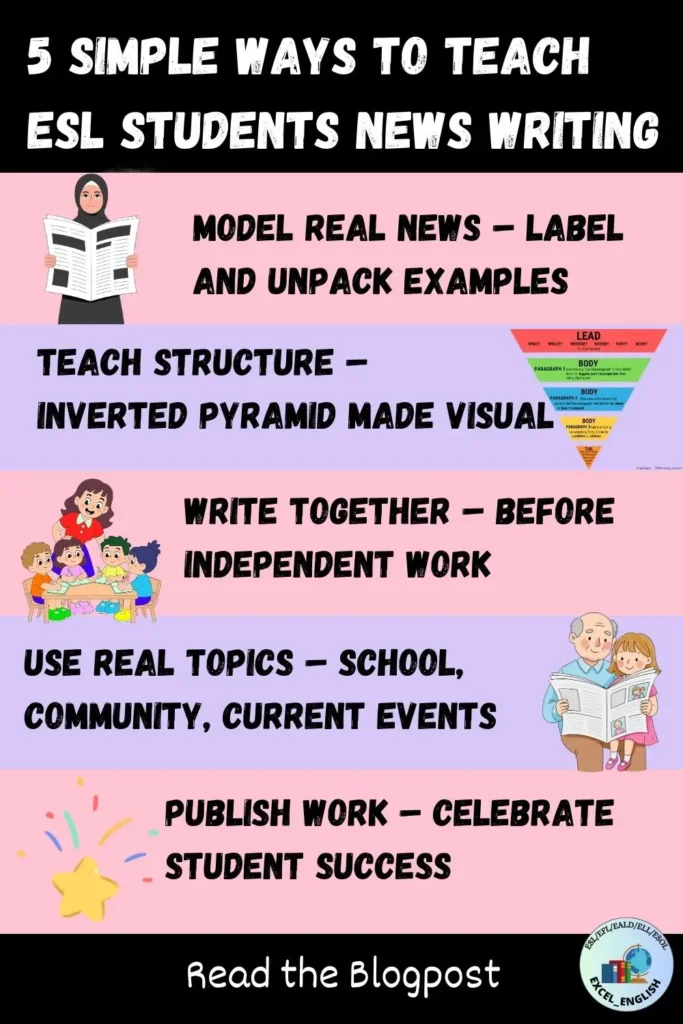
5 Simple Ways to Teach ESL Students News Writing
5 Simple Ways to Teach ESL Students News Writing
Can I say this out loud?
News writing sounds harder than it actually is — especially for ESL students.
Every year in Stage 3 (Years 5–6), I see the same thing. As soon as we say news article, students think it’s formal, confusing and full of rules they don’t understand yet.
And honestly, without the right scaffolding, they’re not wrong.
That’s exactly why I changed how I teach it.
Over time, I’ve landed on a few simple strategies that make news writing for ESL learners feel clear, structured and achievable — even for beginner and emerging ESL learners.
I’ll walk you through them below, and I’ll also share the resource I use in my own classroom to make this unit run smoothly.

Why News Writing Is Actually Great for ESL Learners
Once students get past the fear, news writing becomes incredibly empowering.
It teaches them how to:
pull out key information
organise ideas logically
use formal but manageable sentence structures
answer the 5Ws + H clearly (Who? What? Where? When? Why? How?)
And unlike some other text types, news writing is predictable. That’s a big win for ESL learners.
This is why I always pair my lessons with strong visual support. In fact, early on I usually introduce the unit with visual news prompts and scaffolded planners.
It helps students understand what they’re writing about before worrying about how to write it.

The Challenges ESL Students Commonly Face (You’re Not Alone)
If your students struggle with news writing, here’s why — and it’s not a lack of ability.
I see these issues all the time:
They don’t read traditional news articles
They mix up news reports with narratives or information texts
They don’t know how to write a strong lead
Formal vocabulary feels unfamiliar or intimidating
This is exactly why explicit modelling and scaffolding are so important — and why I don’t jump straight into independent writing.

1. Start With Real News (But Keep It Simple)
I always begin with real examples — short, student-friendly ones.
We read together and label:
headline
byline
lead paragraph
body
conclusion
I’ll often stop and say something like:
“If we only read the lead, what do we already know?”
That question alone changes how students read.

2. Teach the Inverted Pyramid (Make It Obvious)
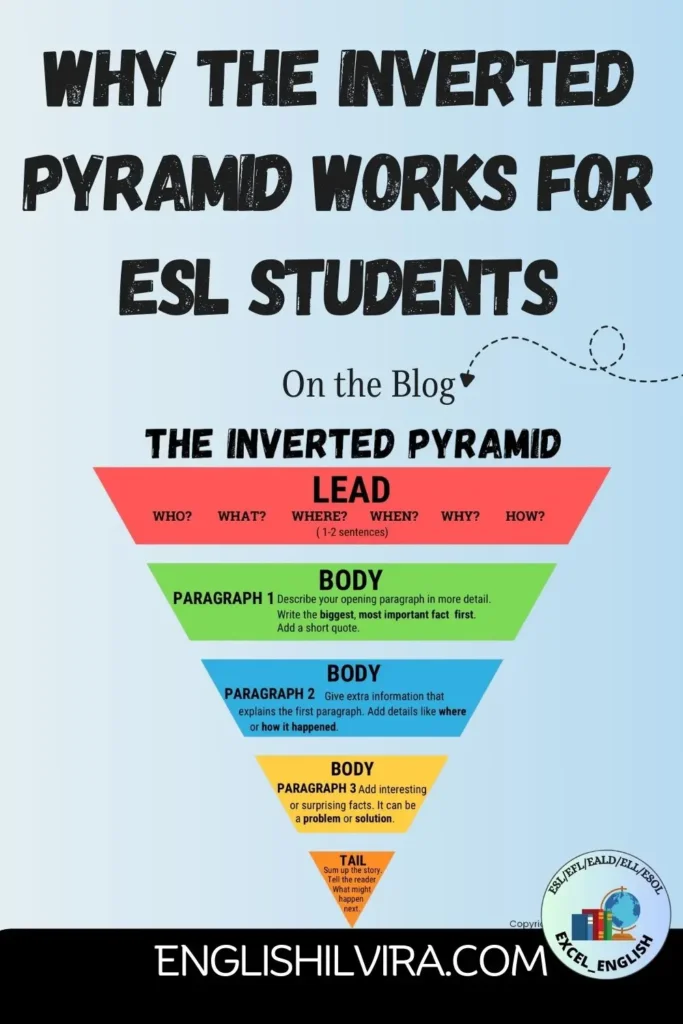
Once students see that news writing follows a clear pattern, they relax straight away. I explain the inverted pyramid like this:
important facts first, extra details next, and background information last.
We draw it. We colour it. We physically match paragraphs to each part of the pyramid. This visual approach really helps ESL learners understand how ideas are organised.
This is where scaffolded planners really shine. Midway through the unit, I move students onto structured planning pages — the same format included in my resource — so they organise their ideas first, before worrying about full sentences or grammar.
3. Write Together Before Expecting Independence
This is the step I never skip. ESL students need to see how a news article is built before they’re asked to do it alone.
We:
write a whole-class article together
co-write in pairs
then move to independent writing
At each stage, students are supported with sentence starters, word banks, and clear expectations for each paragraph.
By the time they’re writing on their own, the structure feels familiar, predictable, and far less intimidating — which makes a huge difference to confidence and engagement.

4. Let Students Write About Things That Matter to Them
Engagement matters — especially for ESL learners. When students care about the topic, they write more confidently and with more detail.
Some of our best articles come from:
school events
excursions
cultural celebrations
environmental projects
kid-friendly current events
Visual prompts help here, too. When students can see the event or situation, they have something concrete to write about.
This reduces anxiety, supports vocabulary choice, and helps students stay focused on organising their ideas rather than worrying about what to say.
5. Treat Writing Articles as a Process (Not a One-Off Task)
We talk openly about drafting, revising, and editing.
I tell students:
first drafts are meant to be messy
revising is about ideas, not spelling
editing is the final polish
Once articles are finished, we publish them — on a class display, a newsletter, or digitally. This is where students feel proud, especially ESL learners who didn’t think they could write a “real” news article.

In Short: What Makes News Writing Work for ESL Students
When you break it down, supporting ESL students with news writing comes back to a few key classroom practices:
Show clear models
Teach the structure explicitly
Write together before working independently
Use familiar topics and visuals
Treat writing as a process, not a one-off task.

Why News Writing Helps ESL Students Beyond English
One thing I’ve noticed over the years is how much news writing supports ESL students beyond English lessons.
Once they understand how to organise information clearly, they start using these skills in other subjects too — science reports, history tasks, even oral presentations.
The confidence that comes from knowing how to structure ideas carries across the curriculum. For many ESL learners, news writing becomes a turning point where writing finally starts to feel manageable and purposeful.

Final Thoughts
News writing doesn’t have to feel heavy or overwhelming.
When you slow it down, model clearly, and give ESL students the right supports, they produce writing that’s structured, confident, and genuinely impressive.
If you’d like a ready-to-use resource that supports this exact approach — with visual prompts, scaffolded planners, and ESL-friendly structure — you can find it on Teachers Pay Teachers here:
👉 News Article Writing for ESL Years 5–6
It’s the resource I wish I had years ago.
And if you’re teaching news writing this term — trust the process. Your students are more capable than they think.
