


Supporting New Arrival Students in the First Weeks of School
Supporting New Arrival Students in the First Weeks of School
Supporting new arrival students in the first weeks of school is some of the most important — and most delicate — work we do as teachers.
Each term in our Sydney primary school, we welcome one or two newly arrived students. Some terms, it’s more.
Since COVID, the number of new arrival students has increased, and their backgrounds are more diverse than ever.
Some students arrive with strong literacy skills in their first language. Others have experienced disrupted schooling or long periods without formal education.
What they all share is this:
they are learning a new language, a new school system, and a new culture — all at once.
As an EAL/D teacher, I see the first few weeks as a critical window. This is where trust is built, routines are learned, and students decide — often unconsciously — whether school feels safe and manageable.
The way we support newly arrived learners during this time shapes everything that comes next.
In this post, I’ll walk you through how I support new arrival students in the first weeks of school, drawing on classroom experience and the research-informed principles outlined in Pauline Gibbons’ work.

Why the First Weeks Matter for New Arrival Students
The early weeks after arrival are not about “catching students up”.
They are about settling in, feeling safe and gaining access.
New arrival students are not beginners in thinking. As Pauline Gibbons explains, they already have:
-
a first language
-
conceptual knowledge
-
cultural understanding
-
lived experience
What they may not yet have is the English needed to show this — or the confidence to participate.
Silence, hesitation or withdrawal in the early weeks is often a sign of intense cognitive work, not lack of ability. When we understand this, our teaching decisions change.

Preparing the Classroom to Welcome Newly Arrived Learners
Supporting new arrival students in the first weeks of school starts before the student even walks into the classroom.
Whenever possible, I work with classroom teachers to:
-
talk to the class about welcoming a new student
-
discuss what it feels like to be new to a country
-
set clear expectations for kindness and patience
This helps shape a positive classroom culture and prevents the new arrival student from feeling like an outsider from day one.

Orientation: Helping New Arrival Students Feel Safe
One of the first priorities is orientation.
We take time to show the student:
-
where the toilets are
-
where to line up
-
where they eat
-
where to go for help
Not knowing where to go — or how to ask — can be extremely stressful. When students understand the physical layout of the school, their anxiety drops almost immediately.
Teaching Survival English Early
In the first days, I explicitly teach survival language, such as:
-
“Toilet, please.”
-
“Help.”
-
“I feel sick.”
-
“I don’t understand.”
These phrases are taught with:
-
visuals
-
gestures
-
repetition
-
modelling
Pauline Gibbons highlights that not being able to express basic needs can be distressing for children. Teaching survival English early supports both wellbeing and independence.

Using a Buddy System to Support New Arrival Students
A buddy system can make a huge difference — but only if it’s used thoughtfully.
When selecting buddies, I look for students who are:
-
kind and patient
-
confident with routines
-
socially aware
-
willing to help
If possible, I also consider whether there is a student who shares the same home language. However, I never force this. Some students want that connection; others prefer to use English only.
The role of the buddy is not to translate everything.
It is to:
-
model routines
-
provide social connection
-
help the student feel less alone
This aligns closely with Gibbons’ emphasis on social participation as a foundation for language learning.

Assessing New Arrival Students Without Pressure
Early assessment is important — but it must be gentle and purposeful.
In the first weeks, I focus on observation and informal checks, such as:
-
Can the student follow simple instructions?
-
Can they identify classroom objects?
-
Can they respond non-verbally (pointing, matching, nodding)?
I might ask:
-
“What’s your name?”
-
“How old are you?”
-
“Point to the door.”
If a student responds in their first language, I accept it. Acknowledging and valuing the home language supports confidence and identity.
At this stage, assessment is about understanding the learner, not labelling them.

Respecting the Silent Period in the Early Weeks
One of the most important principles in supporting newly arrived learners is respecting the silent period.
Many new arrival students listen for weeks — sometimes months — before they feel ready to speak. This does not mean they are not learning.
Instead of pushing students to talk, I look for:
-
following routines
-
responding to gestures
-
joining activities
-
watching peers closely
As Gibbons explains, language production follows understanding — not the other way around.

Learning Through Participation, Not Just Language
In the first weeks, I prioritise activities that allow students to participate without relying heavily on English.
These include:
-
art and craft
-
sport and movement
-
music
-
hands-on activities
These experiences allow students to feel capable and included from day one.

Small Group Interaction for Language Development
When students begin to use English, small groups are far safer than whole-class situations.
I create opportunities for:
-
pair work
-
small group tasks
-
picture-based discussions
-
shared drawing and labelling
Peer interaction is one of the strongest drivers of language development. Students are far more willing to take risks when the social pressure is lower.
In NSW, Australia, newly arrived students are withdrawn from their mainstream classes for small-group English language support. You can read more about the New Arrivals Program in Australia here.

Visual Support and Predictable Language
Visual support is essential when supporting new arrival students in the first weeks of school.
I consistently use:
-
pictures and diagrams
-
gestures and modelling
-
repetition of key phrases
-
predictable sentence structures
New language is introduced slowly and recycled often. This supports comprehension and reduces cognitive overload.

Valuing the First Language of New Arrival Students
Whenever possible, I encourage students to use their first language.
This might include:
-
writing in their home language
-
reading books in their first language
-
explaining ideas using their strongest language
Pauline Gibbons strongly advocates for building on first-language knowledge, as it supports — rather than hinders — English literacy development.

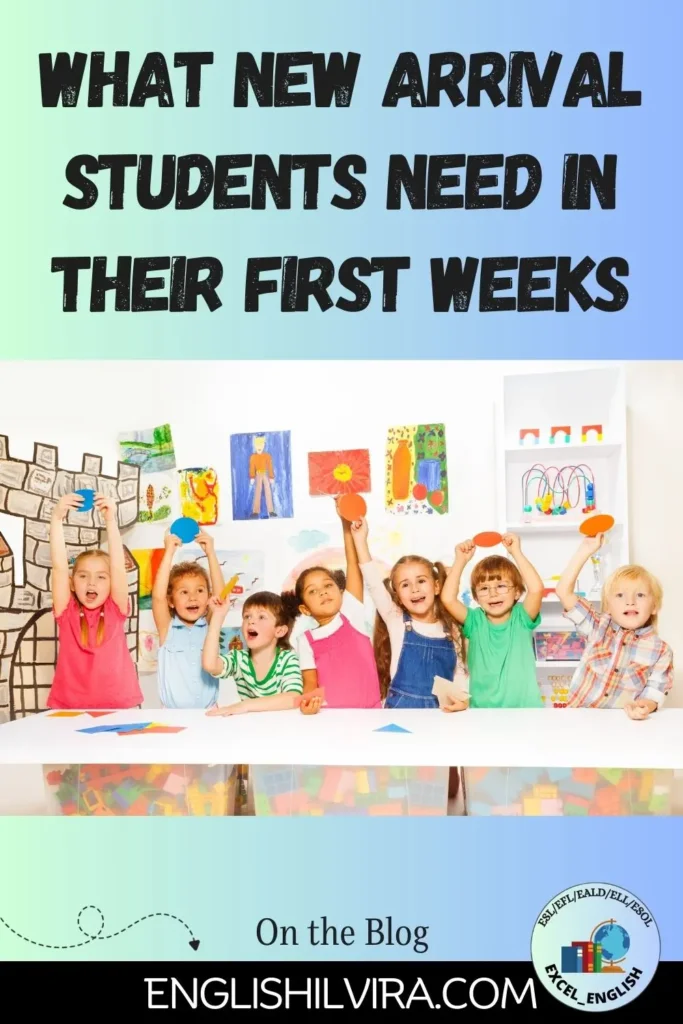
Common Needs in the First Weeks (Quick Overview)
In the first weeks of school, new arrival students have a number of key needs that must be carefully supported.
These include wellbeing, through safety, clear routines, and reassurance; language, with a focus on survival English, strong visual support, and frequent repetition; and learning, supported through hands-on activities and small-group instruction.
Social support is also essential, with buddy systems and peer inclusion helping students feel connected and confident. Finally, assessment in the early weeks should be based on observation and carried out without pressure, allowing students time to settle and demonstrate understanding in different ways.
A Practical Resource to Support New Arrival Students
Over the years, I realised that teachers often need something structured to support new arrival students — especially in those first weeks.
That’s why I’ve created a New Arrivals Program for Kindergarten and primary students.
It’s designed to support newly arrived learners as they settle into school, build confidence, and begin learning English through clear routines, visual support, and scaffolded language activities.
👉 You can explore the New Arrivals Program here:
Related Blog Posts You May Find Helpful
If you’re interested in reading more about supporting EAL/D students, you may also like:
-
How I Assess EAL/D Students Without Pressure
-
What New Arrival Students Need in Their First Weeks of School
-
Practical Classroom Strategies for Supporting Beginner English Learners